The carrier is confirmed. The loading appointment is booked. The customer is waiting for their order. But the truck doesn’t show up.
And that’s when the calls start. Did the carrier actually confirm? Was the schedule change communicated? Who has the latest information? Is another vehicle available?
While everyone looks for answers, the dock remains empty, teams have to reorganise, and warehouse planning starts to drift off course.
A carrier no-show may seem like an isolated incident. However, it is often the result of an issue that started much earlier: a confirmation lost among emails, a change communicated by phone, or an appointment planned without taking the warehouse’s actual capacity into account.
Because booking a transport appointment does not necessarily mean that the operation is secured. The difference lies in what happens between planning and execution.
When transport confirmations get lost among emails, phone calls and Excel
Transport appointment management involves numerous stakeholders: sales administration, transport teams, operations, warehouse teams, dock staff and carriers.
When each of them uses a different channel to share information, maintaining a common view becomes complicated.
As long as the operation follows the plan, these disconnects may go unnoticed. The problem arises when there is a delay, capacity changes or the carrier does not respond.
That is when questions arise that should have an immediate answer: Is the transport confirmed? What arrival time has been assigned? Does the carrier have the correct instructions? Is the dock still available?
If answering these questions means checking emails, consulting an Excel file and calling several people, the operation is already consuming resources before it has even started.
The most common issues include:
- Confirmations scattered across emails and phone calls.
- No shared status between transport, warehouse and carrier.
- Changes that are difficult to track.
- Time spent manually confirming operations.
- Risk of working with outdated information.
And there is another variable that should not be overlooked: the warehouse’s actual capacity to handle all these changes.
Having a carrier available at 10:00 does not necessarily mean that the site can load it at 10:00. There may be no dock available, an unexpected activity peak may occur, or there may not be enough resources to handle the operation.
That is why an appointment should not simply represent a time slot. It should represent an operation that the site can actually execute.
The impact of a carrier no-show on the customer experience
When a carrier does not show up, the problem starts at the dock. But it does not necessarily end there.
The team has to locate the carrier, find an alternative, reorganise the loading operation and adjust warehouse planning. If the incident causes a late departure, the next element at risk is the delivery.
That is when an operational issue becomes a service issue.
Shippers are increasingly monitoring indicators such as OTIF (On Time In Full), which measures whether a delivery arrives on time and in full; OTD (On-Time Delivery), focused on meeting the delivery deadline; or DIFOT (Delivery In Full, On Time), which combines both criteria.
SLAs (Service Level Agreements) also come into play, defining the service levels agreed with the customer.
The chain can be very simple:
Unconfirmed carrier → no-show at the dock → replanning → loading delay → shipment delay → risk of missing the delivery.
And when the failure reaches the customer, it is no longer simply an internal inefficiency. It can affect service KPIs, generate penalties and damage customer loyalty and satisfaction, which are increasingly measured objectively and therefore have a direct impact on revenue.
That is why effective transport planning is not simply about finding a carrier and booking a time slot. It is about ensuring that the operation reaches execution with the lowest possible level of uncertainty.
Connecting transport with the warehouse’s actual capacity
Transport and the warehouse handling of the same goods cannot be planned as if they were two separate operations.
An appointment determines the resources required at the site. And the site’s capacity determines which appointments it can handle.
Docks, loading and unloading areas, available staff and expected activity levels all form part of the equation. If these elements are not taken into account, it is possible to create a seemingly sound plan that cannot actually be executed.
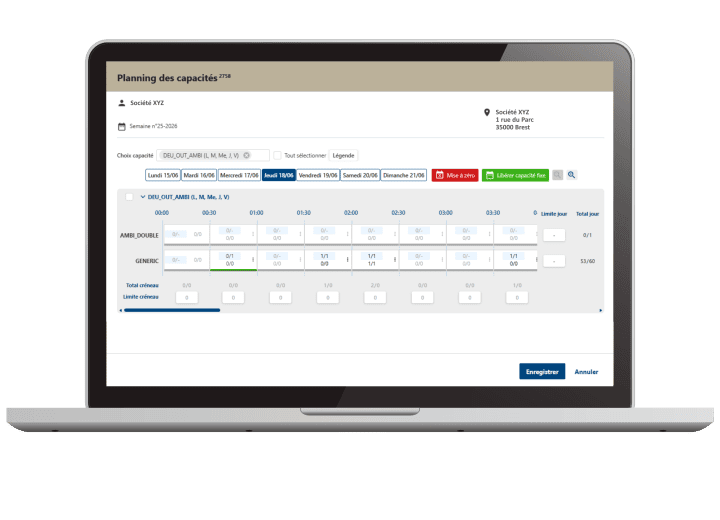
This connection is precisely what lies behind Capacities & Appointments, the standalone module of OneWorld, ACSEP’s TMS.
Its approach is based on a simple idea: a transport appointment is only truly secured when there is capacity to handle it.
The solution connects appointment planning with the resources available and the site’s expected activity, providing a shared view of operations. It can also be used integrated with OneWorld or deployed independently on top of the existing information system.
This means appointment management goes beyond simply booking time slots, making it possible to anticipate potential capacity constraints, coordinate resources and maintain greater traceability of changes.
Capacities & Appointments: from a confirmed appointment to a truly prepared operation
When capacities, appointments, confirmations and changes are managed in a connected way, it becomes easier to know what is planned, what has changed and where a risk exists.
With Capacities & Appointments, operations are managed from a centralised view. Notifications make it possible to communicate confirmations, changes or replanning to the stakeholders involved, while teams can focus their attention on the operations that actually require intervention.
This is where exception management comes into play: it is not about manually monitoring every transport throughout its entire journey, but about identifying operations that deviate from the plan and taking action on them. In OneWorld, this is referred to as “exception management”.
The objective is to reduce calls and emails to confirm information, improve traceability and react before an incident affects the delivery.
More controlled execution also helps protect indicators such as OTIF, OTD and DIFOT, as well as the service levels defined in SLAs. At the same time, it facilitates the monitoring of other execution indicators such as ETA (Estimated Time of Arrival), OTP (On-Time Performance) and POD (Proof of Delivery).
Transport reliability starts before the truck arrives
Reliable transport does not start when the vehicle enters our shipper customers’ premises.
It starts much earlier: when the operation is planned, available capacity is checked, the carrier is confirmed and an appointment is booked that the warehouse can actually handle.
Want to reduce no-shows and make your transport appointments more reliable?
Discover how Capacities & Appointments can synchronise warehouse capacity, transport time slots and operations from a centralised view.
Find out more:
What is a carrier no-show?
A carrier no-show occurs when a carrier fails to show up for a previously planned and confirmed loading or unloading appointment. This situation can disrupt dock operations, tie up teams and cause delays in shipments or deliveries.
How can carrier no-shows be avoided?
To reduce no-shows, it is essential to ensure reliable appointment confirmations, centralise information, track changes in real time and check that the warehouse’s actual capacity allows the planned operations to be handled.
Why is transport appointment management important?
Transport appointment management makes it possible to coordinate carriers with the capacity available at the warehouse. It helps reduce time-slot conflicts, dock congestion and the risk of operational disruption.
How can dock management be optimised?
Dock optimisation relies, among other things, on better time-slot planning, taking available capacity into account, greater visibility of upcoming operations and monitoring changes and exceptions.
What role does a TMS play in transport appointment management?
A TMS makes it possible to centralise and manage transport operations. When it includes appointment and capacity management, it can also help synchronise transport requirements with the resources actually available at the warehouse.
Which KPIs should be monitored to measure transport performance?
Commonly used indicators include OTIF, OTD, DIFOT, OTP, ETA and POD. These KPIs help monitor delivery performance, execution quality and overall transport performance.