Just another Tuesday, and a customer sends an email: “There’s a delivery from four months ago that doesn’t add up.” Nothing urgent at first glance. They haven’t even attached a document. It’s simply a question.
Yet this seemingly harmless sentence is about to trigger an internal investigation that will reveal an uncomfortable fact: the company knows the goods were delivered. What it doesn’t know is whether it can prove it within the required timeframe…
Because in the transport industry, a shipment doesn’t end when the truck is unloaded. It only ends when someone, months later, is able to reconstruct exactly what happened: when the goods were delivered, who received them, under what conditions, and with which supporting documents.
Document traceability under operational pressure
Every delivery leaves a trail: the order, the agreed rate, the transport conditions, communications with the carrier, any incidents and, finally, the proof of delivery. None of these documents is actually lost. They simply end up in different places.
The proof of delivery remains on the carrier’s platform. The rate negotiation is buried in a discussion thread in an email account archived in someone’s personal mailbox. The pre-invoice sits in another system, while an incident that occurred during the shipment exists only in a note discussed over the phone and never formally recorded. No one deliberately decided to scatter this information: it simply happened, shipment after shipment, over the course of weeks.
As long as volumes remain low, the system works thanks to human memory. But memory has its limits. With thousands of shipments and multiple carriers, what once seemed organised turns into a kind of ghost archive: it exists, but no one knows how to reconstruct it quickly.
Every new shipment adds another piece to a puzzle that no one is assembling in real time. This is where an administrative issue turns into a genuine legal and financial risk. Traceability is no longer guaranteed by a process; it depends entirely on one person’s memory — a person who may eventually change roles or leave the company.
The operational cost of improvisation
Let’s go back to that claim made four months ago. Someone will have to locate the shipment, find the POD, check the date, verify whether an incident was reported, confirm the applicable conditions and, if there is a financial issue, trace the related invoicing as well. All while continuing to manage the day’s shipments.
This work usually falls to the transport operations or administration team: teams that were not trained to act as document archaeologists, but who now spend hours on a task that appears in none of their performance indicators or budgets.
The more time passes, the worse the situation becomes: an email belonging to an employee who has since left, a rate change that was never recorded, a screenshot kept “just in case” and now nowhere to be found. Multiply this search across several simultaneous requests, such as during a full audit, and the simple “we’ll take a look” turns into several days of coordinated work across different departments.
The fragility of document traceability is not noticeable on a daily basis. It becomes apparent at exactly the most critical moment: under the pressure of an audit, a customer claim or a dispute, when facing a demanding customer and when financial stakes depend on being able to retrieve the right document in time.
Centralised document management and automated traceability
The answer is not to archive more documents, but to stop waiting for a problem before putting documentation in order.
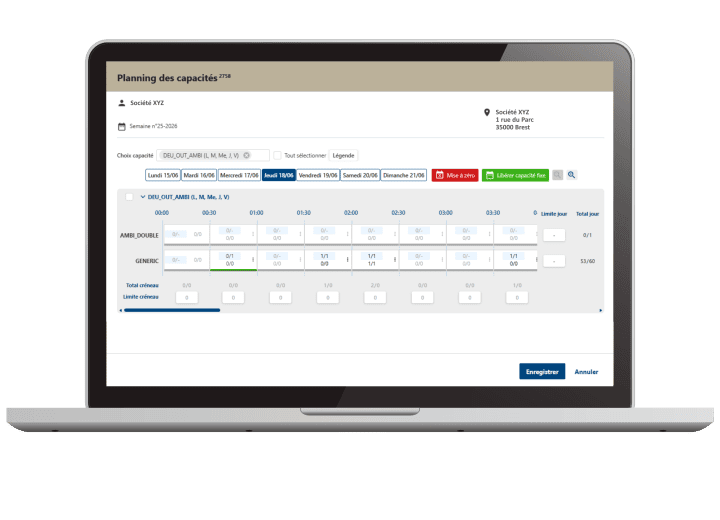
The Compliance module of OneWorld, ACSEP’s TMS, is based on this principle: traceability is built throughout the transport process, not reconstructed afterwards. Every proof of delivery, validated pre-invoice or relevant communication is automatically linked to its original shipment, with no need to manually create folders or manage archives.
Combined with the invoicing modules and collaborative portal, this digital file remains accessible both to internal teams and the carriers concerned, without relying on email follow-ups or searching through inboxes.
The tangible result: what previously required several days of research involving different people and systems can now be reduced to a few minutes of consultation by a single person, from one centralised interface. The immediate benefit is a reduced legal and financial risk associated with gaps in document traceability.
Responsibility for a delivery does not end when the truck leaves. To be effective, traceability needs to be in place before anyone even asks the question.
Ready to modernise the way you manage transport documentation?