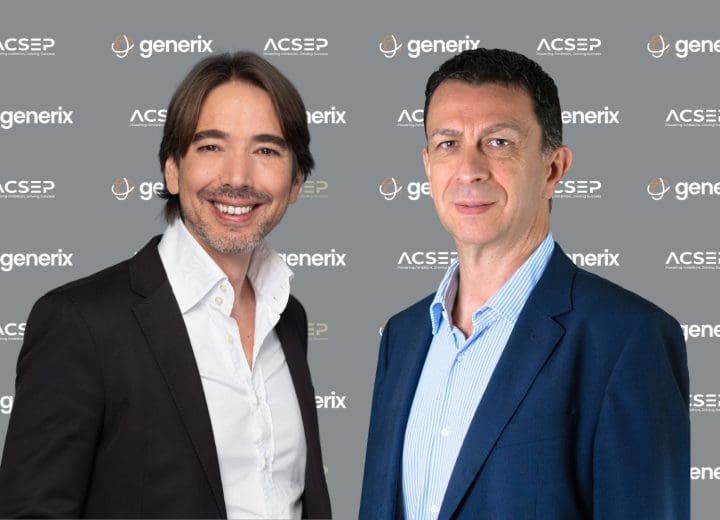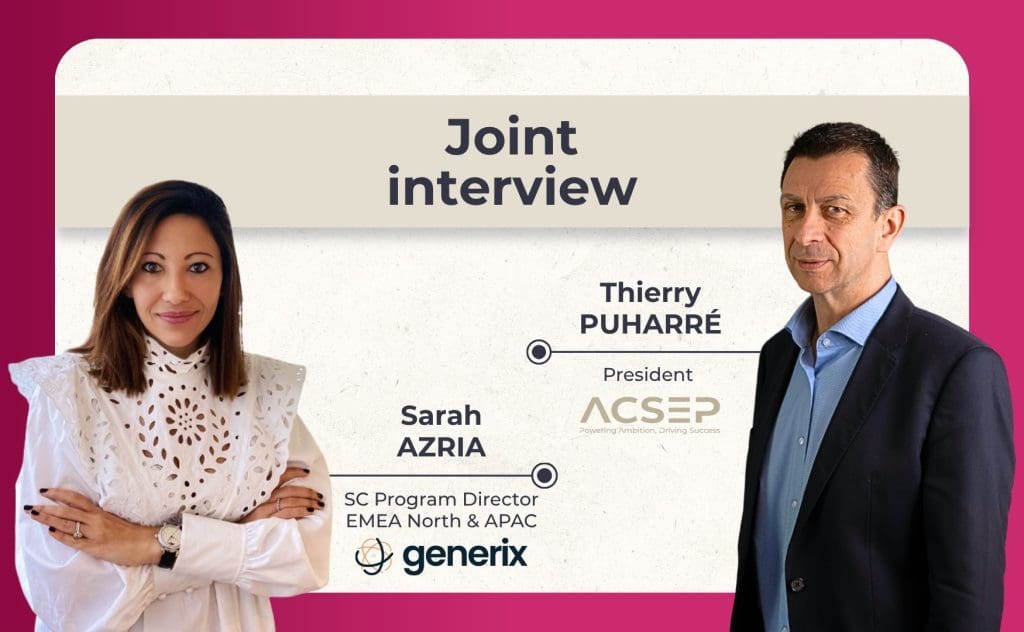
Following the announcement of our new partnership with software provider Generix, read our joint interview featuring Sarah Azria, Director of Supply Chain for EMEA North & Asia-Pacific at Generix, and Thierry Puharré, President of the ACSEP Group. From modernizing legacy IT systems to transitioning to SaaS WMS, and from embedding AI to driving frontline change management, our two experts share their complementary visions for transforming logistics performance.
What major challenges do you see today in the digital transformation of the supply chain?
Sarah Azria: Today, the supply chain operates in a high-pressure environment where demands for responsiveness, visibility, and resilience have never been greater. Many organizations still grapple with legacy systems that are hard to upgrade, data siloed across disjointed tools, and fragmented internal structures. The challenge isn’t purely technological. It’s about modernizing without disrupting day-to-day operations, establishing a reliable and unified data foundation to anticipate needs, and managing operations in real time. At the same time, companies face mounting pressure to prove return on investment quickly. This reality is accelerating the adoption of agile solutions built on SaaS, data, and automation. Finally, AI opens huge potential for forecasting, decision-making, and operational optimization. But true success comes down to translating those innovations into practical, value-driven applications for frontline teams.
How do these challenges play out in practice on the ground?
Thierry Puharré: In a warehouse, digital transformation faces a hard operational reality: you cannot simply halt operations to upgrade your IT system. The WMS sits at the core of logistics, and businesses today demand fast, measurable results while keeping operations completely secure. That means modernizing systems incrementally, integrating more automation, connecting disparate IT components, and leveraging data better—all without letting service levels drop. For us, a project’s success isn’t just about going live. It’s proven afterward on the floor: through productivity gains, inventory reliability, service quality, fewer incidents, and the agility to absorb business shifts. Change management and robust, measurable KPIs have become absolute must-haves.
In what way is this partnership with ACSEP strategic for Generix?
Sarah Azria: The strength of this collaboration starts with the meeting of two highly complementary skill sets. On one side, Generix provides a robust SaaS platform designed to drive logistics operations forward over the long term. On the other, ACSEP brings deep, real-world expertise in field operations, organizational structures, and systems integration. That combination is what makes our partnership so powerful: moving forward faster, but above all moving forward right—delivering useful innovations that get deployed properly and truly adopted by teams.
Why is Generix a natural partner for ACSEP?
Thierry Puharré: Generix offers a remarkably rich, highly configurable WMS tailored to complex logistics environments. Their shift toward SaaS, alongside the deeper integration of data, AI, and automation, mirrors the exact transformations we see among our own clients. Meanwhile, ACSEP brings deep mastery of Generix WMS across functional, technical, and operational dimensions. Our teams understand integration hurdles, legacy technical footprints, warehouse constraints, and modernization roadblocks. It’s a natural fit: Generix supplies the power and scalability of its software, while ACSEP brings field expertise and the capacity to turn that technology into real operational performance for our clients.
How do your areas of expertise complement each other?
Sarah Azria: In any supply chain project, value emerges when three pillars move in sync: product vision, integration, and operational adoption. Generix drives the technology and product roadmap, creating solutions that evolve continuously and quickly integrate high-value innovations. ACSEP brings client-site fluency, vast logistics project experience, and the ability to guide teams through daily usage. Our synergy lives right there—turning software innovation into concrete, deployable, and sustainable operational performance.
Thierry Puharré: A WMS’s value goes far beyond its feature list. It depends entirely on how well it fits into the client’s existing set-up and, crucially, how smoothly it gets used daily inside the warehouse. That’s precisely where our paths cross. Generix builds and evolves the solution. ACSEP steps in right where logistics happens: functional design, integration, upstream/downstream interfaces, automation equipment interfacing, user training, deployment, support, and ongoing operations. Our ability to handle both the Build and Run phases is critical—it keeps us anchored in the client’s context throughout the entire lifecycle of the WMS. Ultimately, we bridge the gap between software capabilities and operational realities.
How does SaaS WMS transform logistics performance?
Sarah Azria: SaaS WMS transforms logistics by making continuous improvement far more accessible. Businesses can adopt new features faster, scale solutions to shifting volumes, standardize processes across multiple sites, and roll out new use cases without heavy upgrade cycles. This model also simplifies embedding innovations like AI, advanced analytics, and automation to tackle specific challenges—like forecasting demand spikes, prioritizing tasks, and optimizing resource allocation. This ongoing agility boosts team responsiveness, execution quality, and operational control. The IT infrastructure instantly becomes a direct performance driver.
What are the key success factors for a successful WMS transition to SaaS?
Thierry Puharré: First off, you can’t treat a move to SaaS as a simple technical migration. It’s an end-to-end transformation project. You must start by thoroughly auditing the baseline: processes, custom developments, interfaces, data flows, operational constraints, and dependencies across the broader IT ecosystem. From there, you streamline workflows, cut out unnecessary legacy customizations, and align as closely as possible with standard software practices. The migration path itself must be tightly secured—through robust testing strategies, performance benchmarks, dry-run cutovers, business continuity plans, and post-launch support. Finally, get operational teams involved early. A successful SaaS project is one that modernizes tech while streamlining and securing day-to-day operations and future updates.
What role do AI, advanced analytics, and automation play in this evolution?
Sarah Azria: AI, advanced analytics, and automation fundamentally shift how operations are managed, moving teams from a reactive stance to proactive anticipation and recommendation. On the warehouse floor, that means catching weak signals sooner, prioritizing tasks intelligently, and pointing staff toward the best decisions. Analytics provides visibility, automation handles repetitive execution reliably, and AI adds predictive depth and decision support. Their job isn’t to replace human expertise, but to amplify it by giving teams sharper tools to drive daily performance.
How can we get frontline users to adopt these innovations?
Thierry Puharré: You must start from real use cases and actual pain points, not from the technology itself. AI, analytics, or automation only matter to a warehouse manager or operator if they make it easier to anticipate workload surges, make faster decisions, eliminate low-value tasks, or improve accuracy. We focus on concrete use cases backed by clear before-and-after metrics. It’s also vital to involve managers and key users early, test on controlled scopes, and listen to feedback. True tech adoption happens when the innovation fades into the background—when users don’t think about the tech, they just notice they’re working better and faster.
What concrete benefits can customers expect from this partnership?
Sarah Azria: For a client, the immediate win is closing the gap between transformation strategy and operational execution. Generix delivers innovation capacity via data and AI, while ACSEP brings hands-on project management, field insight, and secure deployment. Together, we minimize risks, shorten deployment timelines, and deliver clear, tangible outcomes: better visibility, smoother workflows, faster decision-making, and higher operational efficiency.
Thierry Puharré: The core advantage is bringing together the software publisher’s native product mastery and deep-seated operational integration expertise under one roof. That cuts down risk, secures the transition path, and shortens the distance between a technological upgrade and actual warehouse execution. This blend is invaluable for companies modernizing an existing Generix setup, prepping for a SaaS migration, integrating automation, or simply looking to squeeze more performance and control out of their current WMS. Most importantly, we stay with the client for the long haul: from needs analysis through deployment, right through to ongoing support and continuous operational refinement.
What is your shared vision for the next steps?
Sarah Azria: With ACSEP, we want to go beyond individual project wins. We’re building a lasting, high-value collaborative dynamic for our clients. We share a solid foundation—complementary expertise, shared ground-level insights, and a mutual drive to accelerate innovation without adding complexity. The next chapter is pushing further together: pinpointing high-impact use cases, learning from deployment feedback, and scaling repeatable rollout frameworks. The goal is straightforward: helping businesses modernize their supply chains more smoothly, securely, and sustainably.
Thierry Puharré: Our ambition is to turn this partnership into a true transformation accelerator for Generix customers. I see three primary areas of focus: driving the modernization of legacy setups and their transition to SaaS; securing and optimizing remaining on-premises environments; and smoothing out the adoption of emerging capabilities in automation, data, and artificial intelligence. We also want to leverage our combined strengths to industrialize our methodology—from assessment and transformation roadmaps to integration, migration, deployment, and long-term support. Ultimately, the mission is simple: pair Generix’s product innovation with ACSEP’s integration prowess so our clients can transform their supply chains faster, with lower risk and measurable operational results.