Many companies have already taken the step of implementing a TMS. On paper, everything seems to be in place: digitalization, traceability, control… Yet in day-to-day operations, the reality often feels very different.
Costs continue to rise, teams work under constant pressure, and many key decisions are still made “the way they’ve always been done.” So the question arises: why, if I already have a TMS, do I still not have real control over my transport operations?
The answer is often uncomfortable, but clear: having a TMS does not mean you are managing transportation strategically.
Having a TMS is not the same as managing transport effectively
In many companies, the TMS has simply been integrated as another operational tool. It is used to launch shipments, track deliveries, or record information. And yes, that already brings value.
But the problem is that the operational intelligence still exists outside the system.
The most important decisions — which carrier to choose, how to group loads, when to consolidate shipments, or which deliveries to prioritize — are often still made based on experience, urgency, or habit.
This creates a clear disconnect:
- A passive system: the tool executes orders but does not guide strategy.
- Isolated teams: transport managers make decisions without a structured decision-support system.
- A fragmented vision: the lack of global flow optimization prevents economies of scale.
- A reactive approach: employees spend their time reacting instead of anticipating issues.
Signs that something isn’t working
There is no need for a complex audit. There are very clear warning signs that appear in daily operations when transportation is not properly managed:
- Budget overruns: costs keep increasing, but it is difficult to identify why.
- Routine purchasing habits: companies keep using the same carriers out of habit, without real competition.
- Billing errors: discrepancies between expected rates and received invoices are frequent.
- Lack of visibility: there is no real-time, end-to-end overview of shipment status.
- Decision silos: each transport operator applies their own selection criteria.
These situations are common, but they should not be normalized. At their core, they all point to the same issue: an unstructured management approach that depends too heavily on individuals.
The limitations of a TMS when used only as an execution tool
The most common mistake is not technological — it is methodological.
In many organizations, the TMS is used purely as an execution tool. In other words, it simply applies decisions that have already been made outside the system.
This severely limits its potential.
- Business rules are not defined within the system.
- Carrier selection criteria are not automated.
- Optimization depends on individual employees.
- The system does not truly centralize operations.
In this scenario, the TMS is not improving performance. It is merely digitizing processes whose logic remains manual.
What are the key functions of a modern TMS?
A modern TMS should not be limited to simply “managing shipments.” Its real value lies in helping companies make better decisions — consistently.
To achieve this, the solution should enable companies to:
- Manage through data: leverage Business Intelligence (BI) to guide strategy.
- Compare in real time: instantly evaluate carrier rates and performance.
- Automate business rules: integrate operational constraints directly into the system’s allocation engine.
- Drive continuous performance: constantly balance logistics cost reduction with service level compliance (OTIF).
The transformation is not technical — it is cultural. Companies move from managing tasks to managing transport performance control.
The three pillars to turn your TMS into a performance driver
For a TMS to deliver real value, three key elements must be activated:
1. Gain Clear Visibility Over Data
Without reliable and consolidated data, there is no room for improvement. Companies need clear, shared KPIs.
2. Support Operational Decision-Making
The system must proactively help teams choose the right carrier, route, or load grouping — not simply record decisions that have already been made.
3. Coordinate the Entire Operation
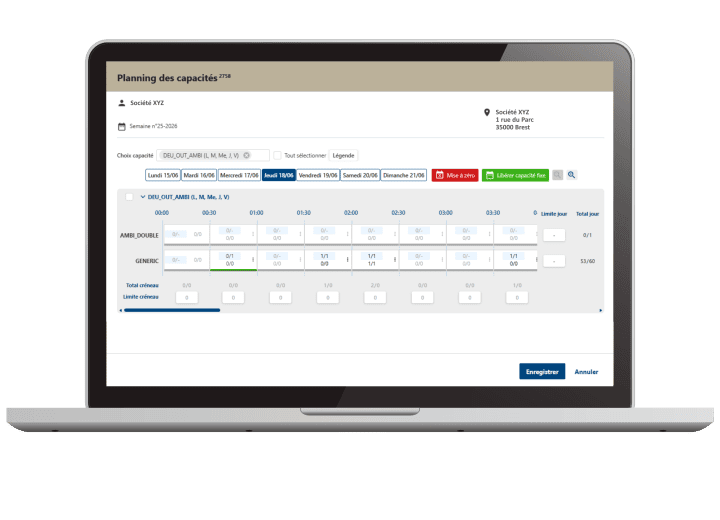
Capacities, appointments, incidents, stakeholders… everything must be connected to avoid friction and wasted time.
When these three pillars are in place, transportation stops being a source of problems and becomes a true efficiency driver.
OneWorld: the game changer for your Supply Chain
This is where solutions like OneWorld, ACSEP’s TMS, make the difference.
It is not just about managing transportation – it is about having a complete, real-time view of what is happening across your ecosystem and being able to act accordingly.
With a collaborative and intelligent approach, OneWorld enables companies to:
- Automate key decisions and reduce operational workload.
- Compare and select carriers based on objective criteria.
- Gain global, end-to-end visibility over all flows.
- Reduce costs and avoid billing discrepancies.
- Anticipate issues instead of reacting too late.
By centralizing data, stakeholders, and operations within a single platform, companies achieve something fundamental: consistency in decision-making.
And in transportation, that makes all the difference.
What really changes in Day-to-Day operations?
When transportation is properly managed, the impact is quickly noticeable.
Teams stop working under constant pressure and feel supported in improving operations:
- Less time spent solving issues.
- Faster decisions with less uncertainty.
- Improved service levels.
- Real reductions in transportation costs.
- Better relationships with carriers and partners.
But above all, companies regain a sense of control. They move from “putting out fires” to running operations with confidence and visibility.
Technology without strategy is meaningless
In a context where transportation costs continue to rise and operational complexity keeps increasing, technology alone is not enough.
The real difference lies in how it is used.
Companies that structure their transportation processes, rely on data, and automate decision-making are the ones that become more efficient and competitive.
Because in the end, the key is not simply having a TMS… but turning it into a true management tool. Shall we help you?