
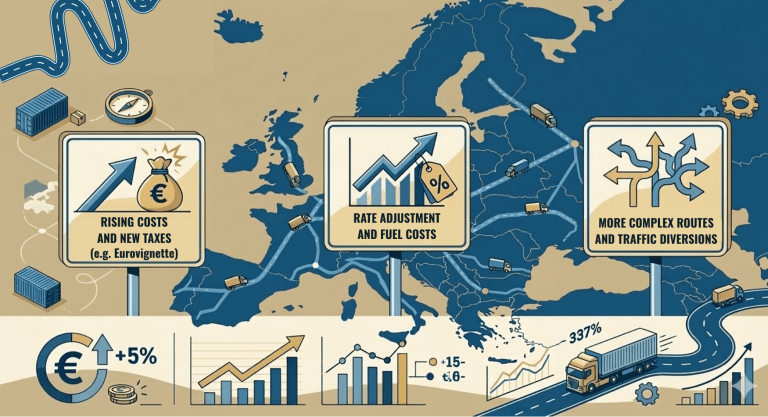
In recent months, many companies have seen their transport costs rise without warning. New taxes, changing rates, more complex routes… What used to be relatively predictable has now become a variable that is increasingly difficult to control.
This situation is no coincidence. Rising geopolitical tensions, trade restrictions and environmental challenges have put additional pressure on a sector that was already operating with tight margins. Transport, which has always been a critical part of the supply chain, has now become one of the main sources of uncertainty for companies.
For many logistics and supply chain managers, the reality is clear: planning transport is no longer just about organizing shipments. It is about managing an economic variable that is becoming increasingly unstable.
In most companies, transport represents one of the largest items in the logistics budget. According to industry data, it can account for between 40% and 60% of total logistics costs.
When these costs increase or fluctuate, the impact is quickly reflected in the bottom line. At the same time, operational complexity also grows.
On a daily basis, logistics teams face situations such as:
Another common issue adds to this challenge: many companies still manage these operations using poorly integrated tools or manual processes. This reduces visibility, increases the risk of errors and makes it harder to optimize decisions.
The result is a common paradox: costs increase, but the ability to control them does not always evolve at the same pace.
Faced with this situation, more and more companies are rethinking how they manage transport. The priority is no longer just ensuring that goods reach their destination, but understanding exactly what is happening in each operation and what it really costs.
This means having visibility over all shipments, controlling rates and surcharges, being able to compare transport options and monitoring incidents in real time.
In other words, companies must move from reactive management – solving problems as they arise – to a more proactive, data-driven approach.
This is precisely where Transport Management Systems (TMS) are becoming increasingly strategic in supply chain management.
A TMS centralizes all transport management within a single platform: shipment planning, carrier management, cost control, shipment tracking and performance analysis.
Beyond digitalization, the real value of these tools lies in their ability to automate operational decisions and optimize resource utilization.
This enables companies to respond faster to an increasingly volatile logistics environment.
In this context, solutions such as our OneWorld TMS transform the way companies manage their transport operations.
Designed for shippers, 3PLs and 4PLs, OneWorld is a configurable and interoperable Transport Management System that centralizes and automates the management of logistics flows.
Thanks to its advanced algorithms and open architecture, the solution enables companies to:
This approach allows companies to move from fragmented transport management to a global, centralized control of their operations.
In a context where every euro counts, optimizing transport has a direct impact on profitability.
Implementing a TMS like OneWorld delivers concrete benefits such as:
In addition, automated cost management and tariff deviation detection allow companies to quickly identify inconsistencies in invoices.
For logistics teams, this means less time spent on administrative tasks and more time dedicated to optimizing operations.
Another key element of modern transport management is collaboration between the different stakeholders in the logistics chain.
Our OneWorld TMS connects shippers, carriers and logistics operators on a single platform, facilitating information sharing and operational coordination.
Thanks to this shared visibility, all stakeholders can access the information they need: shipment status, incidents, associated documents or tracking data.
This improves communication, reduces errors and contributes to a smoother and more transparent transport management process.
The volatility of the geopolitical environment will likely continue to shape the evolution of transport in the coming years. In this context, the challenge for companies is not only to absorb rising costs, but also to manage transport more intelligently.
Having tools capable of centralizing information, automating processes and improving visibility makes it possible to regain control over logistics flows and strengthen supply chain resilience.
In this sense, solutions such as OneWorld help transform transport from a difficult-to-control activity into a true driver of operational performance.